Key takeaways
- HR is expected to be strategic, but most of its time still goes on repetitive administration.
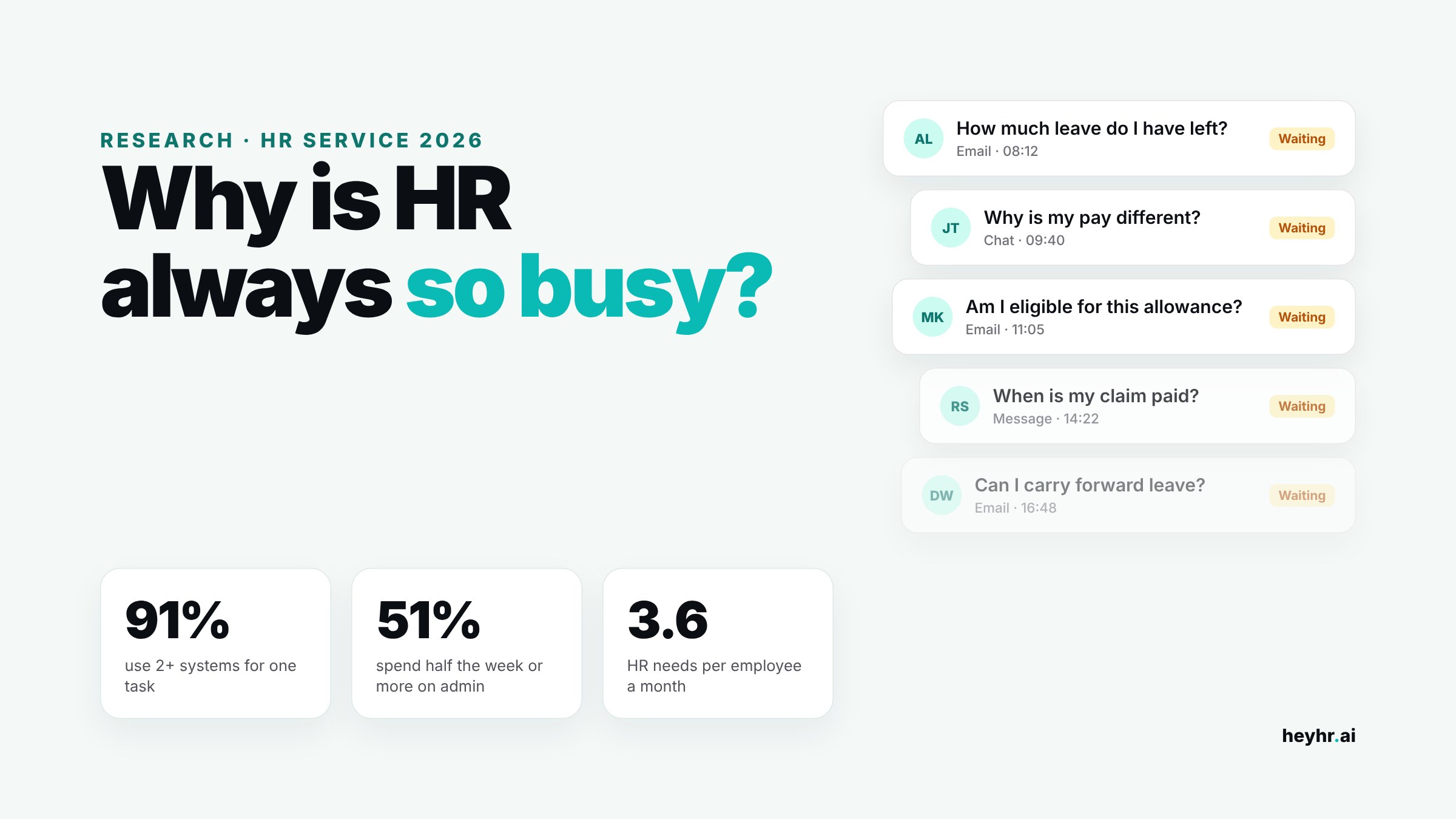
- 91% of HR professionals use two or more systems for a single task, and 78% enter the same data more than once (Eagle Hill, 2026).
- 51% spend at least half their week on routine admin, yet 86% say AI and automation already help. AI has mostly made old workflows faster, not removed them.
- Employees need HR help 3.6 times a month on average, but only 26% go to an HR system first (Applaud, 2026).
- Reducing HR's workload needs AI built on connected data, rules and permissions, not a chatbot added to fragmented systems.
HR teams always seem busy. Often understaffed, constantly responding to requests, and struggling to find enough hours in the day.
Yet employees do not always understand why. Asking about a payslip, checking a leave balance or requesting an employment letter seems straightforward. Why does it sometimes take so long to get an answer?
The reality is that HR handles a large volume of repetitive administrative work and employee questions, and there are surprisingly few tools built to take that work away.
At the same time, organisations expect HR to play a strategic role: developing people, planning the workforce, managing employee relationships and helping the organisation grow.
But how can HR focus on strategy when so much of its time goes on routine administration? Several recent studies show how large this problem has become.
91% use multiple systems. 78% enter the same data again.
According to Eagle Hill Consulting’s 2026 HR technology and service delivery survey, 91% of HR professionals use two or more systems to complete a single HR task. 43% use three or more.
And 78% often or always enter the same information into multiple systems.
In practice, an HR administrator might update an employee’s details in one system, process the related payroll change in another, and keep the supporting records somewhere else.
Moving between systems to finish one routine task, and typing the same information each time, creates work that should not exist. It also creates room for inconsistencies and errors.
The problem is not the number of applications. It is how much work it takes to make them work together. The same survey found that 68% rely on their own workarounds, such as spreadsheets, shared drives and manual tracking.
Technology was supposed to remove repetitive work. Fragmented technology often creates more of it.
Half the week goes on administration
The consequences show in how HR spends its time.
Eagle Hill found that 51% of HR professionals spend at least half their working week on routine, repetitive or low-value administrative work. And 70% say administrative tasks often prevent them from working on more strategic priorities.
These are two sides of the same problem. HR is expected to contribute to strategy, talent development, engagement and compliance, but much of its capacity is used up processing information, coordinating routine requests and keeping administrative workflows moving.
The AI paradox: it helps, but the work remains
Here is the striking part. In the same survey, 86% of HR professionals agree that automation or AI helps them deliver better service.
Yet more than half still spend at least half their week on repetitive admin.
If AI is already helping, why is so much of the work still there?
The likely answer is that most AI in HR today works inside the boundaries of existing software and workflows. It drafts a reply, summarises a document or automates one step. Each task gets a little faster.
But the employee data is still spread across systems. Policies are still disconnected from the workflows that apply them. And HR still has to check information by hand across several tools before anything can be trusted.
In that sense, much of today’s AI in HR has not moved far beyond the automation tools that came before it. It is a faster version of the same process, not a different way of delivering HR work.
Making a repetitive task faster is not the same as no longer having to do it.
Even 30 employees can create 100+ HR needs a month
There is another source of HR workload that is easy to underestimate. Employees have questions. Lots of them.
Applaud’s 2026 State of HR Service report, based on a survey of 1,000 UK employees at organisations with more than 2,000 staff, found that 79% of employees need HR help at least once a month, averaging 3.6 HR needs per employee per month.
Apply that average to a hypothetical company of 30 people:
30 employees × 3.6 = 108 HR needs a month, or roughly 5 every working day.
Not all of these become direct questions to HR. Some are solved through self-service or managers, and the research covered much larger organisations. But the illustration makes the point: even a small workforce creates a steady stream of HR questions and requests.
- “How much annual leave do I have left?”
- “Why is my salary different this month?”
- “Am I eligible for this allowance?”
- “Can I carry forward my unused leave?”
- “When will my expense claim be paid?”
Each one is simple. Together, they take a surprising amount of time.
And employees are not well served either. Applaud found that 36% of employees wait at least a full day for HR help, and only 6% get an instant answer through AI or chat.
HR is busy answering questions. Employees are busy waiting for answers. Neither side benefits.
Built for HR, not for the people HR serves
One of the most telling findings from the Applaud research is that only 26% of employees go to an HR system or portal first when they need help.
After years of investment in HR technology, most employees still prefer to ask a person. They email HR, message a colleague or ask their manager.
Sometimes the information is hard to find. Sometimes the system is unfamiliar. And sometimes employees cannot tell whether the answer they found applies to their own situation.
Traditional HR software was designed around administrative functions: payroll, employee records, leave and approvals. These are essential, but they are organised around what HR administrators need to manage.
Employees are not just records to be managed. They are HR’s most important stakeholders, and in many ways its customers. Yet HR systems have rarely served them directly.
An employee does not care which system stores their leave balance or which module processes their claim. They want an accurate answer, quickly.
We have built sophisticated systems to help HR manage employees. We have not built equally good systems to help employees get help from HR. When employees cannot find answers themselves, they go back to HR, and the cycle continues.
56% still manage employee questions in inboxes and spreadsheets
A third study shows the next part of the problem. Dovetail Software’s 2026 HR Service Delivery Pulse Survey found that 56% of respondents rely on shared inboxes or spreadsheets to manage employee requests. Only 20% use a dedicated HR helpdesk or service delivery platform.
Email and spreadsheets are familiar, flexible and cheap. But as demand grows, they become hard to manage consistently.
- Who is responsible for this request?
- Has it already been answered?
- Which version of the policy was used?
- Who can see this employee’s information?
- What happens when the HR administrator leaves?
These questions matter because HR information is sensitive. Payroll records, contracts, personal data and entitlements need proper access control and careful handling. A shared inbox can be run securely, but only with deliberate controls and ongoing oversight. Without them, informal workflows create problems with confidentiality, continuity, consistency and accountability.
HR’s admin burden is not only about efficiency. It is also about how information is managed and protected.
AI understands the question. Does it know the right answer?
Generative AI changes what is possible. Employees can ask in plain language instead of navigating menus, searching documents or emailing HR, and AI can understand what they mean.
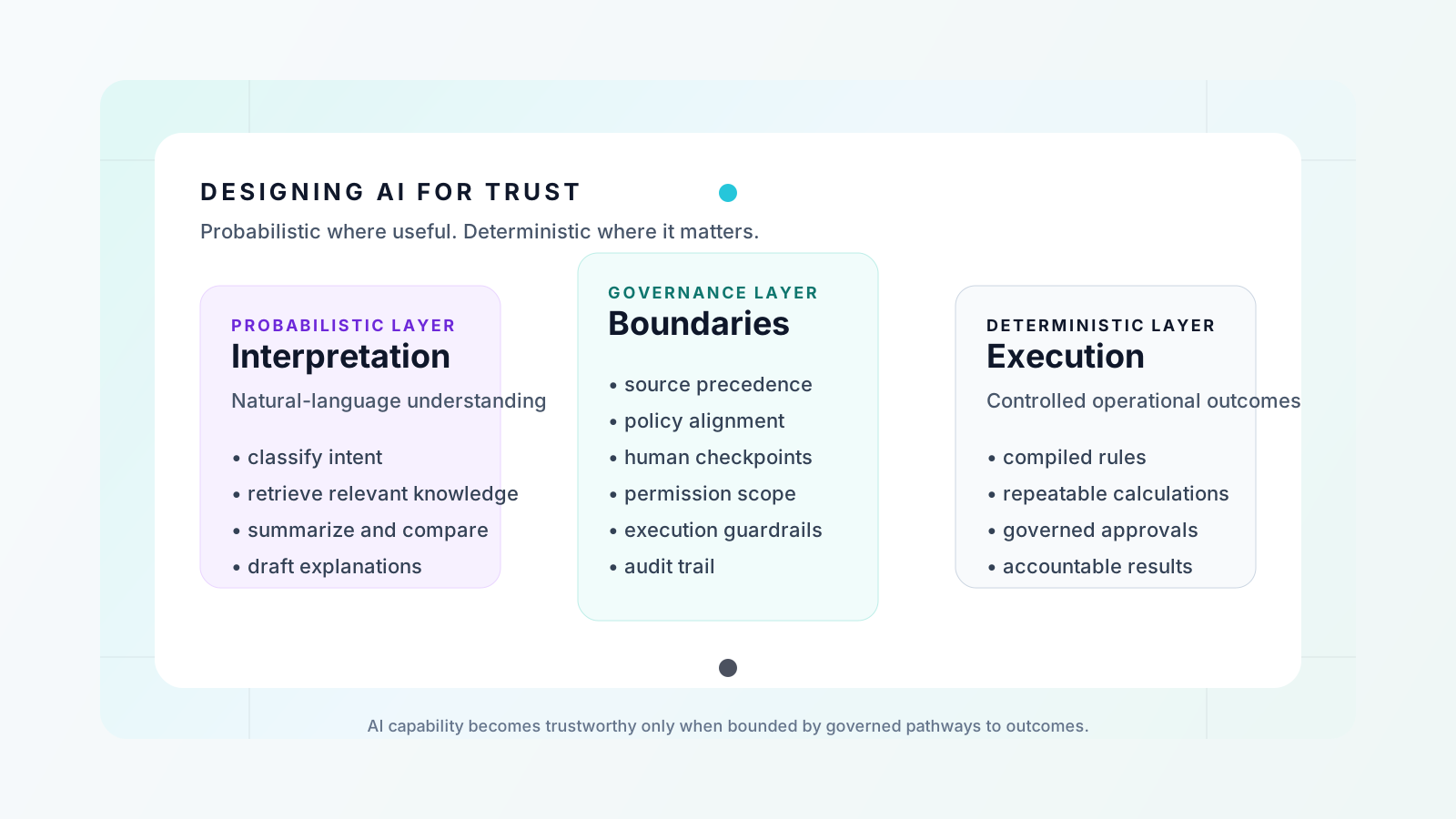
But understanding the question is the easy part. The hard part is making sure the AI has the right information, applies the right rules and respects the right permissions.
Take an employee asking: “Can I carry forward my remaining annual leave?”
Any modern AI model understands the question. But the correct answer depends on the employee’s location, employment contract, statutory entitlements, company policy, length of service and current balance. Some policies apply to one employee and not another. Some information is confidential. Some actions need explicit approval.
A conversational interface alone cannot handle this reliably. The system behind it has to know where the authoritative information is, which rules apply, who may see it and what may be done.
That is the difference between an AI that can answer questions and an AI agent that can reliably do HR work.
HR needs a different foundation
The research points to a consistent pattern. HR spends much of its time on administration. Employee questions create constant demand. Systems are fragmented, and manual processes hold them together.
Adding a chatbot to these systems makes it easier to ask a question. It does not remove the underlying work.
For AI agents to genuinely reduce HR’s workload, they need a foundation that connects employee information, payroll data, statutory requirements, company policies and authorised workflows. That foundation has to answer four questions:
| Question | What it means |
|---|---|
| What is true? | Where is the authoritative, current information? |
| What applies? | Which statutory rules, employment terms and company policies apply to this person? |
| Who is authorised? | What can this person see, and what are they allowed to do? |
| What can be done? | Can the agent answer, prepare a request, or complete an approved workflow? |
As AI moves from giving information to taking actions, these are no longer supporting features. Data integrity, security, policy intelligence and access governance become the core of how AI-native HR systems work.
Giving HR its time back
At HeyHR, we believe this is the change HR technology needs.
We are not building another payroll system with an AI assistant attached. We are building an AI-native HR foundation that connects payroll, employee information, statutory requirements, company policies and authorised workflows.
Our AI HR agent, Metis, helps HR teams with their work and gives every employee a direct way to get HR help.
An employee should be able to ask about their payslip, leave or a company policy without knowing which system holds the answer. An HR administrator should get help with payroll preparation, compliance checks and routine workflows without stitching information together by hand. And the organisation should stay in control of what its AI agents can see and do.
Personal for employees. Governed by your company.
This is not about making HR software a little easier to use. It is about removing the repetitive work that keeps HR from what matters: strategic decisions, compliance, relationships with employees, and the complex situations that need human judgement.
Because the real measure of better HR technology is not how many features it has. It is how much time it gives HR back to focus on people.
Questions
Why are HR teams so busy?
Research points to three causes. HR professionals switch between several systems to complete one task and re-enter the same data, half of them spend at least half their week on routine admin, and employees bring a steady stream of questions that often land in email or spreadsheets.
How many HR questions do employees have?
In Applaud's 2026 survey of 1,000 UK employees at large organisations, 79% needed HR help at least once a month, averaging 3.6 HR needs per employee per month. Applied to a 30-person company, that would be around 108 needs a month, although not all of them reach HR directly.
Why hasn't AI reduced HR's admin workload yet?
In the same Eagle Hill survey where 86% say AI and automation help them deliver better service, 51% still spend half their week on admin. Much AI so far speeds up individual steps inside existing systems. If data stays fragmented and rules stay disconnected, the work itself remains.
Research cited
- Eagle Hill Consulting — HR transformation, work design and AI automation (2026 HR Technology and Service Delivery Survey)
- Applaud — The 2026 State of HR Service Report
- Applaud — Press release, 15 January 2026 (79% seek HR help monthly; 26% go to an HR system first)
- Dovetail Software — 2026 HR Service Delivery Pulse Survey results
Eagle Hill surveyed 200 U.S. HR professionals at employers with US$100M+ revenue (Ipsos, March 2026). Applaud surveyed 1,000 UK employees at organisations with 2,000+ staff (Censuswide, late 2025). Dovetail surveyed HR professionals at mid-sized and large organisations (December 2025; multiple answers allowed). Applaud and Dovetail sell HR service delivery software.