- AI capability alone does not make a system trustworthy in high-stakes operational workflows.
- Trust depends on bounded intelligence, explicit source hierarchy, human checkpoints, and governed execution.
- Payroll and HR show why better retrieval is helpful but still insufficient without deterministic pathways to outcomes.
- HeyHR treats probabilistic intelligence and deterministic execution as complementary but deliberately separated layers.
Probabilistic Where Useful. Deterministic Where It Matters.
AI systems are becoming more capable, but capability alone does not make them reliable enough for every business workflow. In many enterprise settings, especially where outcomes affect pay, compliance, records, approvals, or employee rights, the real challenge is not whether AI can generate a plausible answer. The challenge is whether the system can produce an outcome that is grounded, reviewable, bounded, and repeatable.
This broader concern is reflected in recent governance and testing guidance for generative and agentic AI. NIST’s Generative AI Profile treats confabulation as a concrete risk category and recommends documenting how human domain knowledge is used to improve system performance, including through retrieval, fine-tuning, and business rules. Singapore’s generative AI governance guidance likewise highlights hallucination and inaccuracy as core risks and emphasizes evaluation approaches tied to grounding, retrieval quality, and domain-specific testing rather than relying only on generic benchmarks.
High-stakes systems need more than plausible answers.
They need outcomes that can be reviewed, reproduced, and defended later.
Retrieval quality is not the same as operational reliability.
Even when the right information is found, the model can still misapply it.
Trust comes from governed pathways to outcomes.
That means source precedence, execution boundaries, checkpoints, and traceability.
This matters because payroll and HR are not ordinary question-answering domains. They are operational domains where a system is often expected to interpret rules, apply thresholds, preserve exceptions, respect internal policy, and leave behind an explanation that others can verify later. In such settings, a fluent response is not enough. A useful system must know what it is allowed to decide, what it must escalate, what source takes precedence, and how to reconstruct why an outcome occurred.
Recent guidance for agentic AI reflects the same concern. Singapore’s 2026 Model AI Governance Framework for Agentic AI recommends bounding agents’ powers, defining significant checkpoints where human approval is required, and maintaining technical and process controls across the agent lifecycle. That is the background behind HeyHR’s view of determinism.
Determinism, in the right role
For HeyHR, deterministic does not mean that AI is removed. It means AI is placed in the right role.
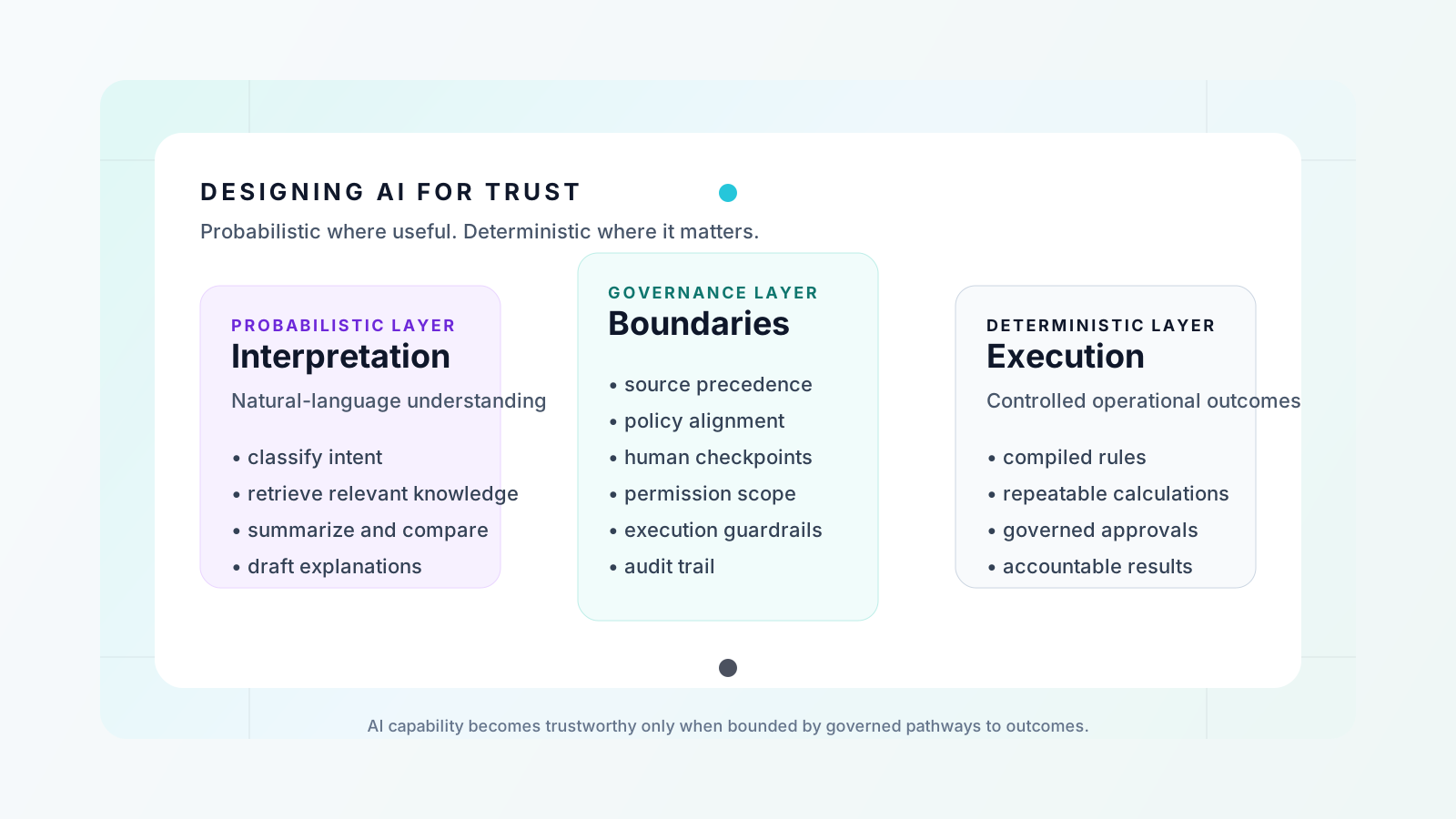
- AI may help interpret, classify, retrieve, draft, compare, and explain.
- But the system should not leave final business-critical outcomes to unconstrained generation.
- Wherever outcomes affect compliance, payroll values, approvals, or auditability, the path to the result should be controlled by structured logic, explicit source hierarchy, and governed execution.
This is not because the industry has already settled on one universal architecture. It has not. GraphRAG, for example, is one emerging response to the limitations of vector-only retrieval. It is best understood as part of an evolving design space, not as a final standard for high-stakes enterprise AI.
HeyHR’s position is that, in payroll and HR, retrieval improvement alone is still not enough.
A better retrieval layer can reduce error. It can improve grounding. It can help an AI system find the right policy, regulation, or precedent. But payroll-grade trust requires more than retrieving the right context. It requires a system that can constrain what AI is allowed to do with that context, route decisions through the right level of control, and preserve a traceable record of how the final outcome was produced.
In HR and payroll, trustworthy AI is not just about better answers. It is about governed pathways to outcomes.
That is why HeyHR does not define AI-native as simply adding a chatbot or attaching retrieval-augmented generation to a legacy workflow. We define it as building a system where probabilistic intelligence and deterministic execution are deliberately separated and coordinated.
Probabilistic where useful. Deterministic where it matters.
The probabilistic layer is where AI adds leverage. It helps turn fragmented regulations, policy documents, employee requests, and natural-language inputs into structured understanding. It helps identify likely relevance, summarize changes, classify intent, highlight conflicts, and prepare explanations. This is where modern AI is strongest.
But the deterministic layer is where the system must become dependable. This is where priorities are enforced, rules are compiled into explicit logic, approvals are triggered, boundaries are respected, and outcomes are executed in a repeatable way.
This design choice matters because even well-grounded LLM applications can fail in more than one way. Singapore’s generative AI governance materials distinguish between problems such as poor retrieval, weak grounding, and inaccurate generation, and recommend testing them explicitly. In other words, even if the right information is retrieved, the model may still produce an output that is not properly grounded in that information. That is one reason HeyHR does not treat retrieval quality as the same thing as operational reliability.
The logic becomes even stronger in specialized domains. Singapore’s generative AI guidance encourages organizations to use domain-specific datasets and fit-for-purpose evaluation for specialized applications. That aligns closely with our view that payroll and HR intelligence cannot be built responsibly on broad, open-ended prompting alone. It requires curated knowledge, scoped evaluation, and a system architecture designed for domain boundaries from the start.
Why this matters beyond payroll
More broadly, this is also consistent with how risk and governance bodies are increasingly thinking about AI adoption. The trend in current AI governance is not toward blind acceptance of model capability, but toward greater emphasis on oversight, bounded autonomy, reproducibility, documented controls, and context-specific reliability. In domains involving employee data, compliance, calculations, and internal controls, that shift is not abstract. It is architectural.
So when HeyHR emphasizes deterministic outcomes, we are not claiming that AI should behave like old software, nor that one particular retrieval method is the answer. We are making a narrower and more practical claim: trustworthy AI needs governed pathways from interpretation to execution.
That means authoritative sources should have explicit precedence, policy interpretation should be translated into structured, machine-usable logic, high-stakes actions should pass through defined checkpoints, execution should happen inside controlled system boundaries, and explanations should be tied back to recorded inputs, rules, and decisions.
This is what makes HeyHR AI-native in a deeper sense. The intelligence is not only in generating text. It is in how the system transforms ambiguity into structured action without losing accountability. AI is used where judgment support and language understanding create the most value. Deterministic control is used where the business needs consistency, compliance, and trust.
That is not anti-AI. It is the discipline required to make AI operationally credible.
Sources
- NIST, Artificial Intelligence Risk Management Framework: Generative AI Profile.
- Singapore IMDA, Model AI Governance Framework for Agentic AI.
- AI Verify Foundation / Singapore, Model AI Governance Framework for Generative AI.
- Microsoft Research, GraphRAG.