- As AI enters HR and payroll operations, the core challenge shifts from output quality alone to security, control, and governed execution.
- A useful system must govern identity, permissions, data access, policy boundaries, workflow actions, and what gets recorded afterward.
- In this domain, governance goes beyond model access. It also includes rule integrity, action boundaries, and accountable execution.
- HeyHR treats governed orchestration as a core architectural layer rather than a secondary compliance overlay.
As AI becomes part of business operations, the central challenge in HR and payroll is no longer access to intelligence alone. It is how that intelligence is governed.
In many software categories, AI is still used mainly to assist users by answering questions, drafting text, or surfacing information. In HR and payroll, the role of AI is expanding beyond assistance. It increasingly touches employee data, policy interpretation, approvals, system actions, and operational outcomes. That shift creates a different architectural requirement.
An AI-native HR or payroll system cannot rely on generative intelligence alone. In this domain, governance matters more.
That governance layer must do more than control model access or filter outputs. It must define who can invoke what, under which identity, with what permissions, against which policy boundaries, and with what record of execution. In a domain shaped by privacy obligations, financial consequences, compliance rules, and employee trust, these controls are not secondary. They are part of the product itself.
This paper argues that the defining requirement of AI-native HR and payroll is not conversational access, but governed operation. The system must be able to support natural interaction while preserving security, permission boundaries, policy control, auditability, and accountable execution.
This is the design premise behind HeyHR. It is built as an AI-native HR and payroll platform in which agentic intelligence operates within a governed orchestration layer and high-consequence outcomes remain controlled and reviewable.
1. AI in HR and Payroll Is Becoming Operational
The first wave of enterprise AI was largely assistive. Systems summarized information, drafted responses, and helped users retrieve knowledge. Human users remained responsible for deciding what to do next.
That is changing.
AI is increasingly expected to do more than inform. It is beginning to route requests, trigger workflows, retrieve records, apply policies, and support actions across enterprise systems. In HR and payroll, this shift is especially significant because the domain is not only informational. It is operational.
A request about leave may affect eligibility treatment and approvals. A question about payroll may touch sensitive records, pay elements, or statutory handling. A manager action may lead to a downstream compensation or workflow consequence. In these cases, AI is no longer sitting outside the process. It is entering the process.
That shift changes the architectural question. The issue is not simply how intelligently the system responds. It is how safely and reliably it operates once intelligence becomes part of the workflow.
2. This Creates a New Control Problem
When AI is used only to assist with drafting or retrieval, the primary concern is often output quality. When AI becomes connected to operational workflows, the main concern becomes control.
In HR and payroll, that control problem takes several forms.
The system must know who is making a request and in what role. It must determine which employee data that person is allowed to access. It must distinguish between information that may be shown, guidance that may be suggested, and actions that may actually be taken. It must understand whether a request crosses a policy boundary, requires an approval, or should remain read-only. It must preserve a record of what happened and why.
This is not just a user experience issue. It is a security and governance issue.
As AI becomes more embedded in software, the risk is not only that a system generates an inaccurate answer. The risk is that it acts outside intended boundaries, exposes information too broadly, bypasses normal controls, or produces outcomes that are difficult to reconstruct later.
That is why AI-native systems in this domain need more than intelligence. They need a governance layer that sits between interaction and execution.
3. Why HR and Payroll Need a Governance Layer
Every enterprise domain has its own requirements, but HR and payroll impose a particularly high standard.
These systems handle sensitive employee information, role-based permissions, internal policy logic, compliance-sensitive processes, and outcomes with financial or legal consequences. Errors or uncontrolled actions do not remain abstract. They affect records, approvals, compensation, and employee trust.
For that reason, AI in this domain cannot be treated as a lightweight assistant layer added on top of existing software. The system must have a structured way to govern how intelligence interacts with data, permissions, rules, and execution paths.
A governance layer provides that structure.
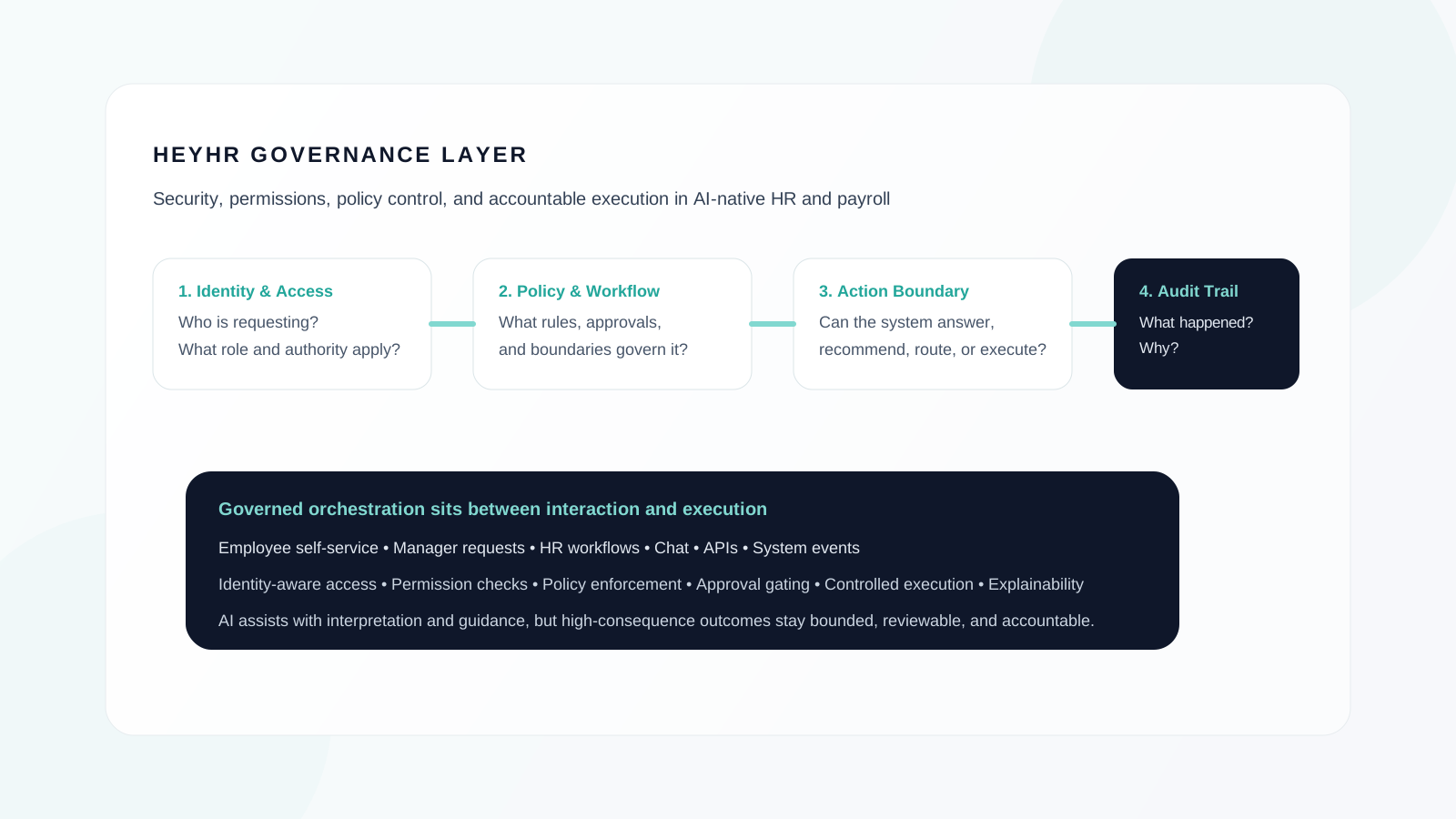
It is the part of the system that decides whether a request is allowed, what context may be used, what boundaries apply, whether escalation or approval is required, and whether the system should answer, recommend, or execute. It is also the layer that makes later review possible by preserving the relevant trail of identity, policy context, system actions, and outcome path.
In an AI-native HR and payroll system, governance is not an external overlay. It is part of the core operating design.
4. What the Governance Layer Must Govern
A meaningful governance layer in HR and payroll must govern more than one thing.
First, it must govern identity and authority. The system needs to know who the user is, what role they hold, what organizational context applies, and whether the request is being made on their own behalf or on behalf of someone else.
Second, it must govern data access. The system should control what employee records, payroll details, policy documents, and contextual information may be accessed, retrieved, or displayed in response to a request.
Third, it must govern action boundaries. There is an important difference between showing information, drafting a response, recommending an action, and actually performing one. The system must know where each boundary lies.
Fourth, it must govern policy and approval conditions. Some requests may require manager approval, HR review, or policy checks before anything further can occur. The governance layer should enforce those conditions rather than assume that all valid-looking requests are actionable.
Fifth, it must govern auditability. Once a system has interpreted a request or supported an outcome, there must be a clear record of what was requested, what context was used, what constraints applied, what action was taken, and what approval or rule path shaped the result.
Without these controls, AI may still appear useful. But it will not be dependable in the ways operational systems need to be.
5. Governance in HR and Payroll Goes Beyond Model Access
In many discussions of enterprise AI, governance is framed mainly in terms of model access, prompt safety, output filtering, or tool permissions. These are important, but they do not cover the full control surface of HR and payroll.
The harder problem in this domain is not only whether the model was used safely. It is whether the system operated within the right organizational and policy boundaries.
A request may come from a valid user and still require additional approval. A manager may be allowed to view some information but not change it. A payroll administrator may be authorized to perform a certain action only within a defined period or under a defined workflow state. An employee may ask a valid question that should produce an explanation but not expose underlying confidential data. These are governance questions, not just model questions.
The governance layer must therefore sit at the intersection of identity, permissions, workflow state, policy conditions, and system behavior. It must decide not only whether the AI can respond, but how the system is allowed to proceed.
This is where AI-native HR and payroll differ from generic assistant patterns. The challenge is not simply to make the system responsive. It is to make the system responsive within disciplined operational boundaries.
6. Rule Integrity and Execution Boundaries
In HR and payroll, governance also reaches into the logic that shapes outcomes.
These systems do not operate only on user prompts and retrieved text. They also rely on company policies, statutory requirements, thresholds, mappings, effective dates, approval conditions, and exception handling rules. That logic influences what the system should say, recommend, or do.
For that reason, governance is not only about access control. It is also about rule integrity.
The system should know which policy version is active, which rule set applies to a particular situation, and whether a given outcome is being evaluated under the correct conditions. If those elements are not controlled, the system may operate within valid permissions and still produce the wrong result.
This is also where execution boundaries matter.
There are parts of HR and payroll where AI can remain interpretive. It can help understand intent, retrieve relevant policy context, guide a user, draft an explanation, or classify an issue. But there are also points where the system crosses into operational consequence. At that point, the path to execution must be controlled more tightly.
That is where deterministic handling becomes important. Not as a headline claim in itself, but as a governed boundary within the broader security and governance architecture.
7. Explainability Requires More Than Logs
A governance layer should not only prevent misuse. It should also make outcomes understandable afterward.
In HR and payroll, this means the system should support questions such as:
- Why was this information shown to this user?
- Why did this request stop at recommendation rather than execution?
- Why was approval required in this case?
- Which policy or rule context shaped the outcome?
- What system action actually occurred?
- Can the path be reviewed later?
Ordinary logging is not enough if it only records that a model was called or that an API request occurred. Operational explainability requires a more structured trail. The system should preserve enough context to show how identity, permissions, policy conditions, workflow state, and execution decisions came together in the handling of a request.
This is especially important in a domain where review, audit, and employee trust matter. Explainability is not only about transparency for developers. It is also about accountability for operations.
8. How HeyHR Approaches the Governance Layer
HeyHR is built on the view that AI in HR and payroll must operate within a dedicated governance architecture.
Its approach starts with the idea that requests can enter through many channels: employee self-service, HR workflows, manager actions, conversational interfaces, APIs, or system events. But regardless of how work enters, the same question applies: what is allowed to happen next?
To answer that, HeyHR places governed orchestration between interaction and execution.
That orchestration layer evaluates identity, permissions, organizational context, policy constraints, workflow state, and approval requirements. It determines whether the system should provide information, guide the user, route the request, request approval, or proceed toward execution.
Within that structure, AI is used where it adds value. It can support interpretation, exception handling, contextual guidance, and user-facing assistance. But those capabilities operate within defined boundaries rather than as an unrestricted layer over sensitive systems.
Where outcomes become operationally significant, HeyHR uses a controlled compliance core so that execution remains precise, reviewable, and accountable. This applies especially in payroll-related handling, where financial and policy consequences require greater discipline than ordinary conversational support.
In that sense, HeyHR is not simply applying AI to HR software. It is designing the governance layer required for AI to operate safely and accountably in this domain.
9. What This Means for AI-Native HR and Payroll
As AI becomes more deeply embedded in enterprise systems, the distinction between helpful AI and governable AI will matter more.
In HR and payroll, AI-native should not mean only that the system is easier to talk to. It should mean that the system has been designed to manage identity, permissions, policy boundaries, workflow controls, and accountable execution as part of its core architecture.
That is the difference between an assistant layer and a governance layer.
The long-term value of AI in this domain will not come from making software appear more intelligent at the surface alone. It will come from making intelligence usable inside real operational boundaries without weakening security, privacy, control, or reviewability.
That is the architectural standard HeyHR is built around.
Conclusion
The central challenge of AI in HR and payroll is not interaction alone. It is control.
As intelligence moves closer to real operations, the system needs a governance layer that can manage who may ask, what may be accessed, what may be recommended, what may be executed, and under what policy and approval conditions.
This is not a secondary requirement. It is the foundation for making AI usable in a domain shaped by sensitive data, permissions, compliance obligations, and employee-facing outcomes.
The governance layer behind AI-native HR and payroll is therefore not just about safety in the abstract. It is about making intelligence operationally trustworthy.
That is the problem HeyHR is built to solve.